

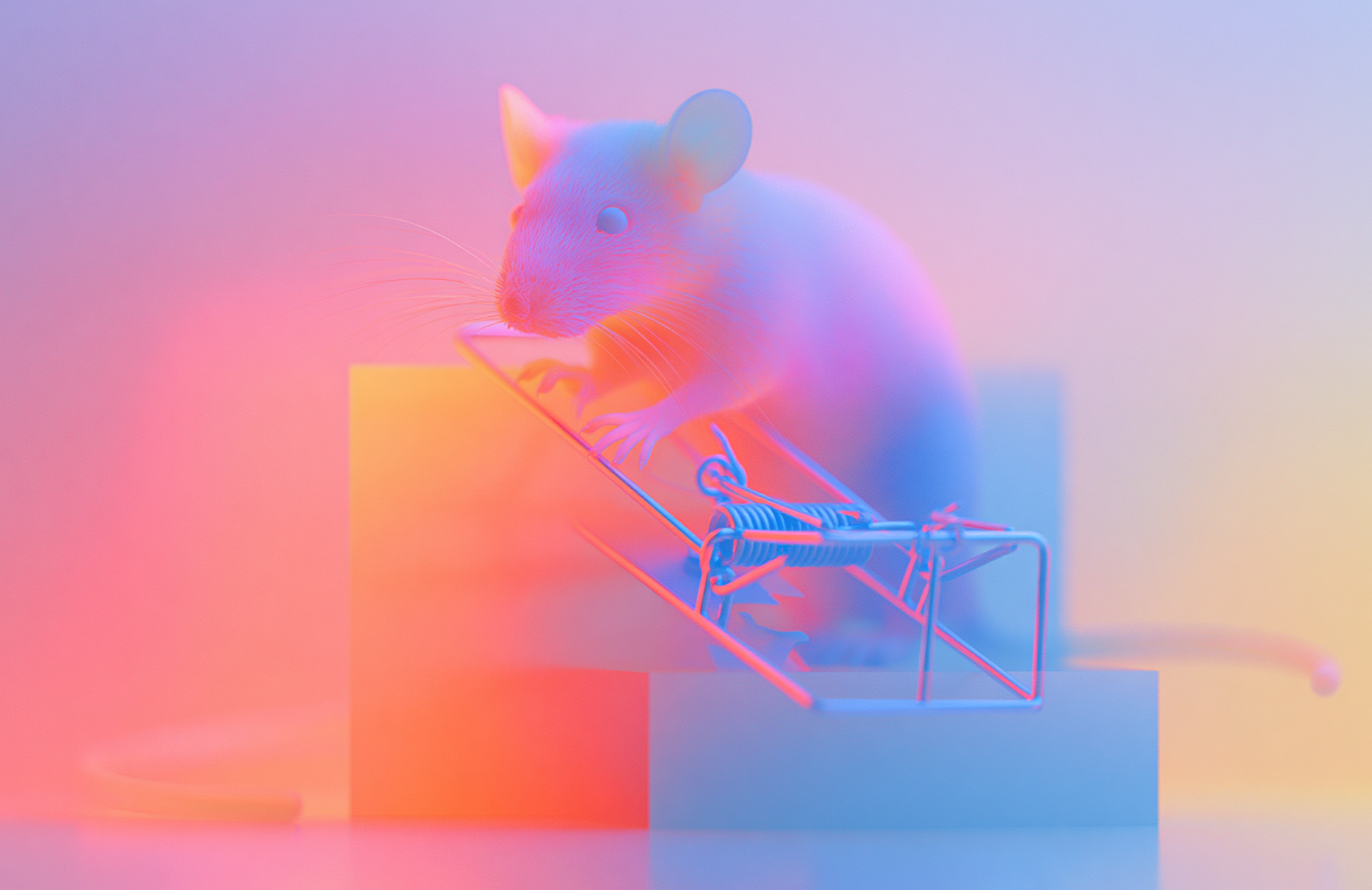
Breaking the Mouse Trap
Why Longevity Research Needs a New Species

For decades, the field of longevity research has been chasing the fountain of youth, and its primary test subject has been the humble lab mouse, acting as the sacrificial hero.
We’ve had mind-blowing results in rodents over the years, but they consistently fail when applied to humans.
It makes one wonder: Are we studying the right species?
The chase for this “fountain of youth” has become a costly and frustrating cycle. Nearly all of therapies that show promise in mouse models fail to translate to humans (by one estimate, 80%). The problem isn’t the science: it’s the model. Mice simply don’t experience life and aging allthe same ways humans do.
Here are a few key factors to this failure:
● Artificial Environments: Lab mice live in sterile, artificial conditions. They’re shielded from the “noise” that defines human life, such as environmental pollutants, social stress, and varied diets. Human aging is shaped by this noise, making lab mice poor stand-ins for us.
● Metabolic Rate: Mice have much faster metabolisms and produce higher levels of reactive oxygen, leading to more oxidative damage. This fundamentally changes how they age and respond to interventions compared to humans.
● Genetic Variation: Inbred mouse strains, commonly used for consistency, lack the genetic diversity found in humans. This limits how well findings can be generalized to a broader population.
Challenges like these have led scientists to search for a species that is genetically diverse and, most importantly, shares our environment: the dog, our closest companion.
Unlike mice, dogs experience aging while influenced by real-world conditions. They don’t live in sterile labs, rather they live in human households. Their diets are less consistent, and their opportunity for play and exercise much greater. While the difference in overall lifespan suggests some difference between us and dogs, it seems likely that the underlying processes of human aging have greater overlap with dogs than mice.
But how can we harness this potential?
We can’t simply put tens of thousands of dogs into a laboratory, that would just recreate the same “mouse trap”, but in a larger cage.
The answer lies in doing the opposite. That’s where Decentralized Science (DeSci) and Dog Years DAO come in, bringing research into real homes.
Imagine millions of dogs contributing data worldwide to a living, open aging study where:
●Owners earn tokens for contributing data,
●Researchers gain access to real-world insights, and
●Breakthroughs are shared instantly across borders.
By breaking the mouse trap, Dog Years DAO isn’t just changing how aging is studied, it’s changing who gets to participate in the study, and how value and power is shared.
Dog owners, researchers, and investors co-own the discovery process.
The secrets of longevity shouldn’t be locked away in a lab.
Every extra year with your dog teaches us how to live longer, too.
Let’s make those years count for them, for us, and for the future of life itself.



Keep up with the latest in canine longevity.
Get updates on trial enrollment, research breakthroughs, and new ways to get involved. No spam — just meaningful science, shared stories, and occasional dog pics.


